When buying a new car, most people don’t think about if there is going to be a problem with the car. It’s a new car right? There’s nothing that could possibly go wrong. Why don’t we ask the family who bought themselves a new Lexus. Unfortunately they are not available because this Lexus killed them in a crash. The accelerator on the car got stuck and the driver could do nothing until they hit another car at 120 mph killing everyone involved. All this could have been avoided. Blood was spilt because of one little problem of the accelerator pedal sticking. Something Toyota overlooked.
There are too many safety issues that are overlooked by car companies today. Safety must be top priority when it comes to a product like a car. Auto safety standards must be updated regularly in order to keep up with the technology of cars. In history NHTSA (National Highway Traffic Safety Association) has been in control of the safety requirements for cars. About every decade they make changes, which is usually right after a major problem or recall.
When it comes to the lives of the people, safety shouldn’t be considered as trial and error. Prevention is the name of the game. If safety was higher on the companies’ priorities then we could prevent most of these defects. One way to make car companies take a better look at safety is to make it cost them if they don’t. By taking the cap off of the fine for recalls and by requiring more safety features, a problem with a car caused by a car company could be devastating to the financial well being of the company. This way safety becomes one with profit. So in order to make money and not lose money, companies will step up on the safety of their car so that they can prevent problems in safety or defects in cars which in turn prevents them from losing money. That’s all they need is a little motivation.
Many of you may be thinking “You can’t prevent every problem” which is true. You cannot simply prevent all problems but we can prevent car companies from neglecting safety and by doing that we can save lives.
Monday, June 14, 2010

Friday, June 4, 2010
Cause and Effect
When it comes to auto safety standards, everything depends on cause and effect. When a problem arises and a recall is set out, that is cause and effect. Car makers are currently controlling auto safety and just doing the bare minimum to get by. With the new bill and the new safety grading this will change. The bill will require much more attention to safety features and the grading will motivate car makers to build cars to compete with these increasing standards so their car can sell.
Wednesday, June 2, 2010
Opposition Arguments
Most people are in favor of the auto safety bill that is coming into play but the car companies are very skeptic about it. Although they don't publish their ideas, they don't like the idea because it will cost them more to build a car. Also they are removing the cap from the maximum fine of $16.4 million which companies are worried could cause them to go bankrupt. If they did argue about it, the argument they would probably use is that it would make cars more expensive for the consumer. They would show how much more you would have to pay for a car to make up for the new safety requirements and new taxes being imposed on car companies. Persuasion by greed would be their method and the consumer would be their target.
Thursday, May 27, 2010
Current Standing
My current standing really hasn't changed much at all. Although I know more about my topic now I see more of a need for Auto Safety Standards to be increased. When I chose this topic I was concerned about the recent recalls and the general safety of the consumer because the companies are failing. When, now that I've been researching, it's really NHTSA who has most of the blame. They have ignored making any changes until a major problem arises. Safety standards should be constantly upgraded not just when there is a massive recall.
Wednesday, May 26, 2010
Definitions
The words I chose were auto safety, NHTSA, recall, black boxes, and super brakes. Basically I chose 2 of these because of common misconceptions, and 3 for clarity so everyone knows exactly what i'm talking about. Auto Safety is my topic so I must define this so the reader knows what type of auto safety I'm talking about. Black boxes is the other common misconception (auto safety was the first) and I wanted to define that because the name "Black Box" isn't an official name but a nickname.
I defined NHTSA because its a lesser known government organization that controls all the aspects of my topic and are extremely important to my ideas. Recall can be confusing as to the exact definition, it is the fixing or repairing of defects created by the producer. Super brakes are new to the auto safety field and need to be defined so my readers know what they are and what their purpose is.
Friday, May 21, 2010
Photo Analysis
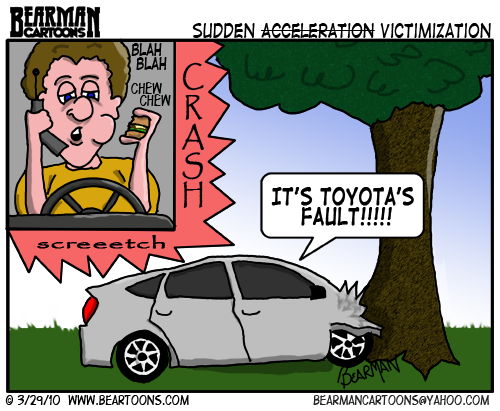
The scene depicted is a driver that is obviously distracted because he is eating and talking on his cellular phone while driving. He then hit’s a tree in his Toyota Prius and blames Toyota for the crash.
The driver speaks the lines or yells the lines and says “It’s Toyota’s Fault!!!!!!”
The cartoonist is showing that some of the accidents reported because of Toyota’s failure to install a safe accelerator pedal may have resulted because of driver error but the driver lied as to not receive the blame himself.
This is important to my argument because it points out arguments against me that i must consider in my writing to get the full effect of my argument. Yes, some of these reported "safety hazards" are really just user error but claimed that it was the car. This way someone may not have to pay for a lawsuit but be paid one themselves.
Wednesday, May 19, 2010
Safety Grades
"To Curb Grade Inflation, Safety Tests Get Tougher" written by Jim Motavalli on March 25, 2010 in the NTY uses many facts to produce his point so I have come to the conclusion that he is using induction to persuade his readers. He uses some analogy as well.
The first thing he says in his article is an analogy. He states that a student coming home with low grades like c's or d's should be cause for concern. With the new rules for "safety grades" coming up, he believes the lower grades will be a cause for concern to car buyers. He again compares the safety grades to teenagers saying that parents would wonder why their child earned an A in one semester of history and then a C+ the next. This is what the new grading system will do to their cars grades.
Claim: The Auto Industry needs to make some changes in the grading scale.
Grounds: Too many cars are receiving a 4 or 5 star rating just because they passed the crash test when they should receive a 2 or 3 star rating because they didn't perform all that well.
Conclusion: The claim is true
I pulled this one straight out of the article because it matches up with the pattern of an induction argument. Here is the passage:
"Cars are already much safer than they once were.
According to the Insurance Institute for Highway Safety, an industry-financed research group, 25,428 passenger vehicle occupants were killed in car and light-truck crashes in 2008, a 17 percent reduction from 1975. A majority of those fatal accidents, 52 percent, resulted from front crashes, but 28 percent — about 7,000 deaths — were from side impacts.
More rigorous testing standards could further reduce fatalities — and help consumers sort out which cars are the safest. "
Claim: Cars are already much safer then they once were. More rigorous testing standards could further reduce fatalities and help consumers sort out the safest cars.
Evidence: the second paragraph.
The first thing he says in his article is an analogy. He states that a student coming home with low grades like c's or d's should be cause for concern. With the new rules for "safety grades" coming up, he believes the lower grades will be a cause for concern to car buyers. He again compares the safety grades to teenagers saying that parents would wonder why their child earned an A in one semester of history and then a C+ the next. This is what the new grading system will do to their cars grades.
Claim: The Auto Industry needs to make some changes in the grading scale.
Grounds: Too many cars are receiving a 4 or 5 star rating just because they passed the crash test when they should receive a 2 or 3 star rating because they didn't perform all that well.
Conclusion: The claim is true
I pulled this one straight out of the article because it matches up with the pattern of an induction argument. Here is the passage:
"Cars are already much safer than they once were.
According to the Insurance Institute for Highway Safety, an industry-financed research group, 25,428 passenger vehicle occupants were killed in car and light-truck crashes in 2008, a 17 percent reduction from 1975. A majority of those fatal accidents, 52 percent, resulted from front crashes, but 28 percent — about 7,000 deaths — were from side impacts.
More rigorous testing standards could further reduce fatalities — and help consumers sort out which cars are the safest. "
Claim: Cars are already much safer then they once were. More rigorous testing standards could further reduce fatalities and help consumers sort out the safest cars.
Evidence: the second paragraph.
Subscribe to:
Comments (Atom)
